
Why Learning SQL Feels So Hard (And How "SQL Essentials for Data Analysis" Fixes It)

SQL Essentials for Data Analysis is Now Available
To make starting even easier, as a subscriber to this newsletter, I’m giving you an exclusive 35% launch discount. You can grab your copy today and start the 50-day journey at a reduced price. Grab it here: Gumroad 35% off.
Grab the paperback version from Amazon: Amazon
If I can help at least one person learn SQL, I will be satisfied.
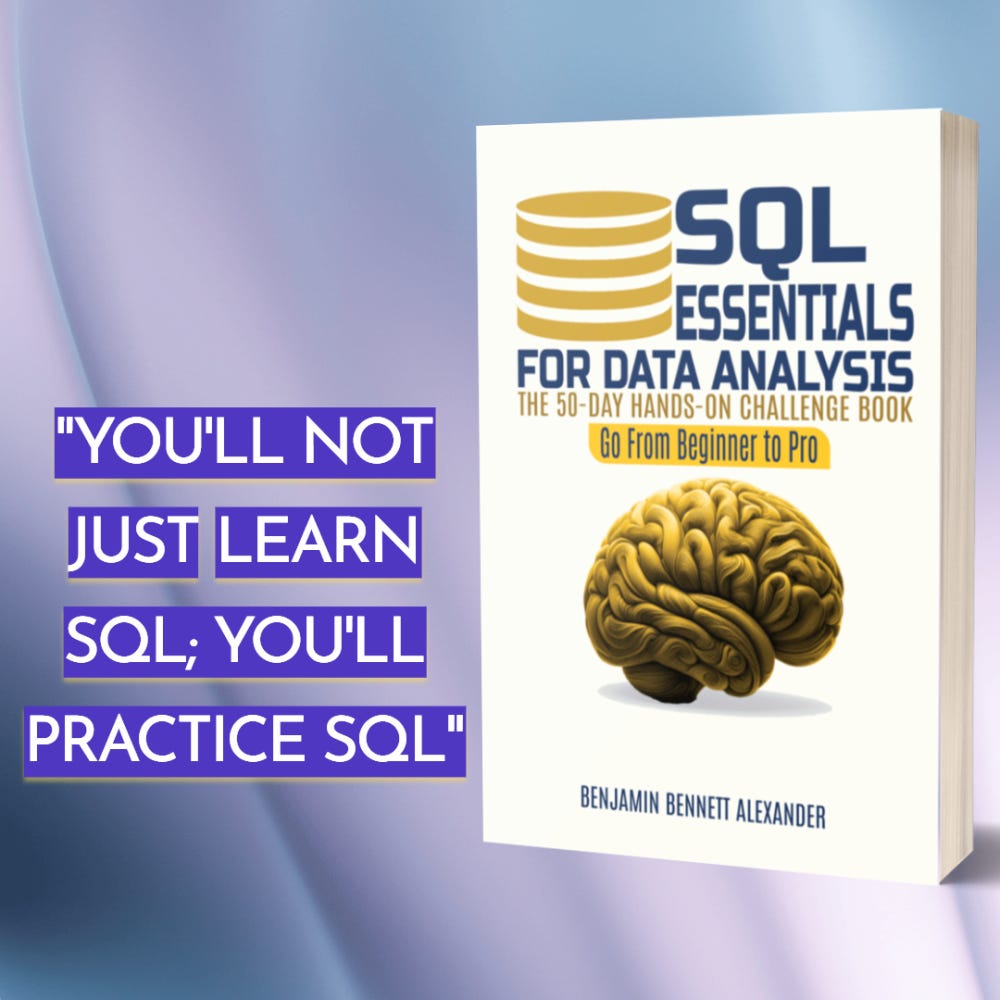
This week, I have made “SQL Essentials for Data Analysis: A 50-Day Hands-on Challenge Book (Go From Beginner to Pro)” available to the public. It’s quite a heavy book with 618 pages. You probably understand why it took me over a year to put together. Basically, my goal was to create a product that provides everything you need to go from novice to a competent SQL user. It covers all vital areas, from writing your first SELECT statement to optimizing queries. If you are just starting your journey, or you’re just looking for a resource that will help you level-up your SQL skills, this book has you covered.
I am truly humbled and grateful by every kind word uttered about the book by those that had a chance to read it. It is also humbling to see people grab copies of the book in the first few days it has been live. If I can help at least one person learn SQL, I will be satisfied.
Let me share with you some of the pain points that SQL learners face and how I used the book to address them.
1. The Illusion of Progress: Reading Without Practice

Have you ever sat in a stationary train that’s next to a moving one? For a brief moment, it feels like your train is moving too. That’s the illusion of movement, and it’s the same illusion many learners experience when studying SQL.
You read tutorials. You highlight queries. You watch someone explain JOINs and GROUP BY on YouTube. And it all makes sense, until you actually try to write a query yourself. Then the screen stares back at you, and your confidence quietly slips away. That’s when you realize you weren’t really moving. You were just watching movement happen.
In SQL, real learning doesn’t happen through passive reading. It happens when you run queries, make mistakes, fix them, and understand why they failed. When you go through that cycle, frustration, correction, clarity, that’s when the concept sticks.
Reading about SQL is like reading about swimming. It feels logical until you’re the one in the pool. That’s why this book was built on practice. I want you to experience what Mike Tyson describes as the “punch in the face moment.” It’s through practice that the illusions of progress are knocked out of your head. Practice will expose all the areas of your journey that require more work. SQL is not about how much you read, it’s about how much you query.
2. The Pain of Setting Up the Environment

Let’s be honest; half the frustration of learning SQL isn’t SQL itself. It’s everything that happens before you even write your first query. You open a tutorial, and before the author even types SELECT, they’ve already asked you to: Install a database, Configure the server, Set up environment variables, Grant permissions, Connect through a command line... And just when you think you’re all set, you get a setup error, and then another error. By the time you’re done, the motivation that got you to start is already gone. That’s one of the biggest barriers for beginners: setup fatigue.
It’s not that people don’t want to learn SQL; it’s that the setup makes it feel like a technical marathon before the actual race even begins. That’s why this book takes a different route. Notebooks are the playgrounds of data analysts and scientists. That is exactly what I use in this book. You will run every single query in a Jupyter Notebook or Google Colab. No complicated installations or permissions. Just you, the data, and the query. If you ask me, it’s the closest thing to removing friction from learning.
Because if the goal is to practice, then the environment should get out of your way, not slow you down.
3. The Messiness of Real-World Data

Most people practice SQL in a perfect world. Every dataset is clean, every query runs smoothly, and every answer matches exactly what the platform expects. But step into the real world, and you’ll quickly realize data rarely behaves that way. It’s like a naughty kid who won’t listen to you.
Real data is stubborn and won’t yield to your “perfect queries.” You’ll find missing values where you expect numbers. You’ll find duplicate rows, inconsistent date formats, typos in column names, and nulls hiding in places that break your logic. And suddenly, those textbook-perfect queries don’t work anymore.
That’s the problem with many online SQL challenges. They give you ideal data, not real data. You never get to wrestle with the imperfections that make real analysis difficult yet meaningful.
This book doesn’t shy away from that. You’ll face datasets that aren’t always polished, because that’s how you build true skill: by debugging messy joins, fixing nulls, and writing queries that hold up when the data doesn’t.
Learning SQL is more than memorizing syntax; it’s about thinking like an analyst when things don’t go as planned. That’s where the real growth happens.
4. The Lack of a Goal (50 Day Format)
It gives you the feeling of being in a bootcamp, but without the pressure or the price tag.

One of the biggest reasons people give up on learning SQL is that they don’t have a clear finish line. They start watching tutorials, solving a few practice questions here and there, and before long, it all starts to feel… directionless. Learning without structure gives the illusion of effort, but not the satisfaction of progress.
That’s why I went with the 50-day format. It’s not just a gimmick; it’s a system with a bootcamp feel. Every day, you take on a new challenge, building one layer of skill at a time.
You wake up knowing exactly what to focus on. You write queries, you debug, you learn, and you do it with purpose. It gives you the feeling of being in a bootcamp, but without the pressure or the price tag. By the time you hit Day 50, you don’t just “know” SQL; you own it. You’ve built the habit, the muscle memory, and the confidence that comes from consistent practice. Real progress comes from direction.
The Bottom Line
SQL is the foundation of every serious data workflow. If you can query data confidently, you can analyze faster, communicate better, and stand out on any data team. I’m just providing the tools to help you learn. All you have to do is put your head down and put in the work.
It is my hope that “SQL Essentials for Data Analysis: A 50-Day Hands-on Challenge Book (Go From Beginner to Pro)” will help you learn SQL the right way, through consistent, structured, and realistic practice. Happy learning and please share with anyone that is trying to learn SQL. Thanks!