
5 SQL Query Patterns That Always Pop Up in Interviews

SQL interviews remain a staple for data analyst, data scientist, backend engineer, and database roles. They are often the real gatekeepers that determine whether you can move forward in the hiring process. Companies do not just need people who know SQL syntax. They need people who can work with data, understand business problems, and turn messy requirements into clear, efficient queries.
A candidate may know how to write a basic SELECT statement, but interviews usually go much deeper. You may be asked to combine multiple tables, handle missing data, calculate business metrics, analyze trends over time, or rank results within different groups.
These questions are designed to test your ability to think like a data professional. In this article, we will explore five SQL query patterns that appear repeatedly in interviews:
SQL Essentials for Data Analysis: A 50-Day Hands-on Challenge Book (Go From Beginner to Pro)
SQL interviews are not about remembering commands. They are about solving data problems. SQL Essentials for Data Analysis helps you build the problem-solving skills required to turn business questions into SQL queries through 50 days of structured, hands-on challenges. By the end, you will have practiced the same patterns that appear repeatedly in real SQL interviews: joins, aggregations, window functions, data cleaning, and analytical queries.
1. Multi-Table Joins & Handling Missing Data (LEFT JOINs, NULLs)
If you do not know the joints, then you will not survive this part of the interview. Most data interviews start with some variation of joining tables and dealing with NULLs. Here is a good example of a typical problem pattern:
You have an orders, customers and products table. Find all customers and their total spend (including those who never ordered).
To answer this question, you must demonstrate your understanding of INNER JOIN versus outer joins (LEFT, RIGHT, and FULL). You must also show how to handle NULL values using COALESCE and correctly apply post-join filtering (WHERE vs. HAVING).
A typical solution would look like this:
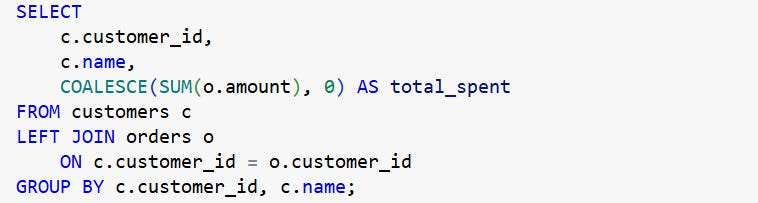
Notice the use of LEFT JOIN. It ensures that every customer appears in the results, even if they have never placed an order. For those customers, SUM(o.amount) returns NULL, so COALESCE() converts it to 0.
If you asked to find customers who never placed an order, then you would add a filter:
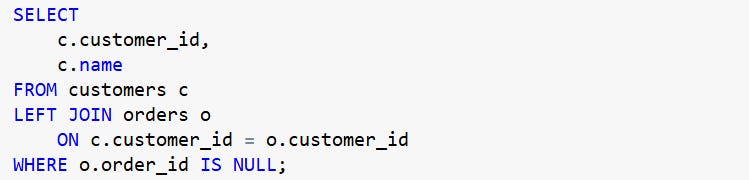
This distinction is a favorite interview topic because it demonstrates whether you truly understand how LEFT JOIN works rather than simply memorizing the syntax.
2. GROUP BY + Aggregations with Complex Conditions
This is a very common question in product analytics or business intelligence interviews.
Here is how a typical problem would be worded:
Find the top 5 products by revenue per country, but only for users acquired in 2024.
To answer this question, a strong understanding of the GROUP BY and HAVING clauses is crucial. You must also be able to perform conditional aggregations using CASE WHEN and rank results within groups using window functions like ROW_NUMBER() or RANK().
A common approach is to first calculate the revenue for each product and then rank those products within each country.
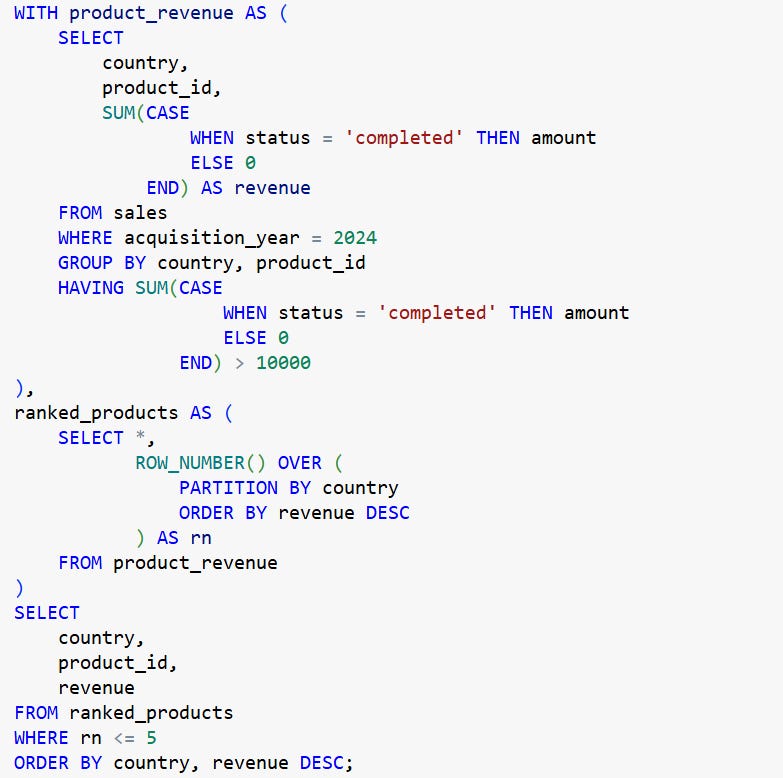
Notice the different roles played by WHERE and HAVING: WHERE filters individual rows before the data is grouped. HAVING filters groups after aggregation. In this example, it removes products that generated less than $10,000 in revenue.
Many interviewers intentionally ask questions like this because they want to see whether you know when to use WHERE, HAVING, and window functions together. It is one of the most frequently tested SQL patterns in data analytics interviews.
3. Window Functions
if your interview is at a modern company, I promise, you will have to battle some window functions. The most common tested areas are:
Running totals / cumulative sums
Rank within partitions (e.g., top N per group)
Comparing current row to previous/next (LAG/LEAD)
Calculating moving averages
Finding first and last values within a partition
Here is a typical example:
For each customer, show every order along with a running total of the amount they have spent over time.
A common solution would look like this:
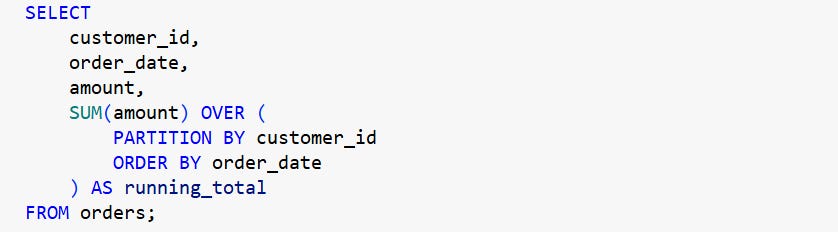
This question tests your understanding of the OVER() clause. Unlike GROUP BY, window functions do not collapse multiple rows into a single result. Instead, they perform calculations across a set of related rows while preserving every row in the output.
Interviewers also love questions involving ranking. For example:
Find the three highest-paid employees in each department.
A typical solution would use ROW_NUMBER() or RANK():
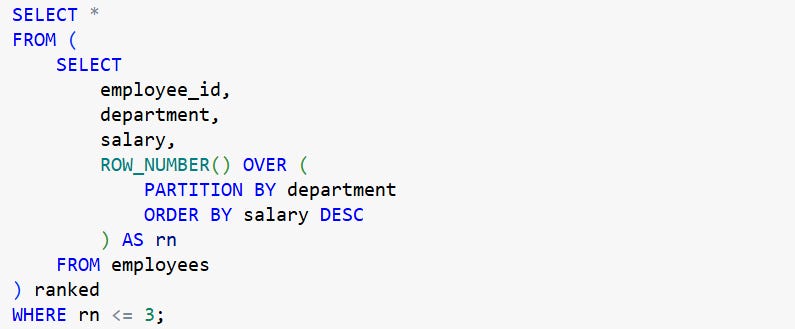
Window functions have become one of the most valuable additions to SQL, and many companies now expect candidates to be comfortable using them. If you can confidently work with SUM() OVER(), ROW_NUMBER(), RANK(), LAG(), and LEAD(), you’ll be well prepared for a large percentage of SQL interview questions. Make sure to learn window functions in 2026.
4. Date & Sequence Problems (Streaks)
Another interview favorite is solving date and sequence problems. These questions test whether you can identify patterns over time instead of simply aggregating data.
Common examples include:
Finding consecutive login days
Identifying purchase streaks
Detecting gaps in activity
Measuring customer retention
Here is how a typical interview question might be:
Find users who logged in for at least three consecutive days.
One of the most elegant solutions uses the gaps-and-islands technique with ROW_NUMBER(). See below:
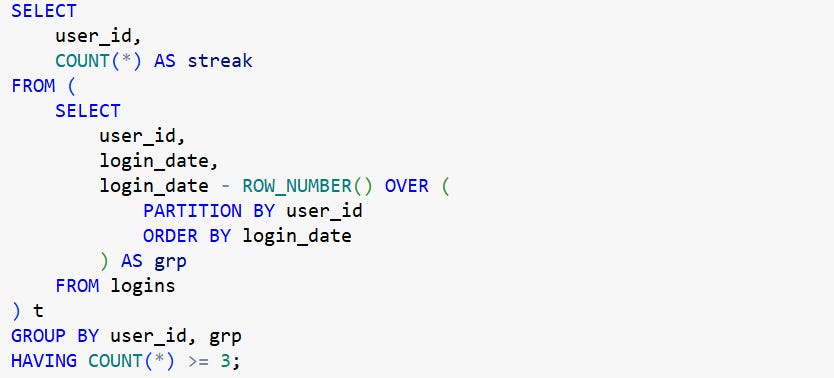
The key idea is surprisingly clever. ROW_NUMBER() assigns a sequential number to each login for a user. When you subtract that sequence number from the login date, every set of consecutive dates produces the same value. This creates a unique group identifier (grp) for each streak of consecutive logins. Once the consecutive dates have been grouped together, you simply count the number of rows in each group and keep only those with three or more logins.
This "gaps-and-islands" pattern appears regularly in SQL interviews because it demonstrates a deep understanding of window functions and sequence analysis. While some candidates attempt to solve these problems with self-joins, interviewers are often looking to see whether you know this more efficient window-function approach.
5. Self-Joins & Date/Sequence Problems
Self-joins are a popular interview topic because they test whether you can think beyond simply joining two different tables. Many beginners find them difficult because the same table is joined to itself to compare related rows.
Interviewers use these questions to assess whether you can solve real-world analytical problems using relationships within a single table.
Self-joins are frequently used for:
Finding consecutive days or activity streaks
Manager–employee hierarchies
Comparing current and previous records
Identifying duplicate or related records
A typical interview question might be the following:
Find customers who placed orders on two consecutive days.
A common solution is the following:

This query joins the orders table to itself. For every order in o1, it looks for another order from the same customer exactly one day later. If a match exists, the customer has placed orders on consecutive days.
While window functions such as LAG() and LEAD() are now often the preferred solution for sequence problems, many interviewers still ask self-join questions because they demonstrate that you understand how relational databases work. In fact, some interviewers may even ask you to solve the same problem twice, first with a self-join and then with a window function, just to compare the two approaches.
Note that the exact date function depends on the SQL dialect. This one above is SQLite.
Wrap-Up
SQL interviews are rarely about memorizing syntax. They are more about application. They are designed to test whether you can think about data problems and translate business questions into efficient queries. The hardest interview questions rarely test one concept in isolation. A single problem may require joins, aggregations, window functions, and filtering logic all in one query.
The best way to prepare for SQL interviews is not to memorize hundreds of solutions. Instead, focus on understanding the underlying patterns. Once you recognize the pattern behind a problem, the SQL becomes much easier to write.
Practice these patterns repeatedly, and you will be prepared for a large percentage of SQL questions asked in real-world interviews. SQL Essentials for Data Analysis: A 50-Day Hands-on Challenge Book helps because it focuses on the exact transition most candidates struggle with: moving from knowing SQL syntax to solving business problems with SQL.